




How to Successfully Invest in a Buy-to-Let Property


When viewing an apartment, it is easy to imagine how it will look once furnished. A bright living room, a terrace and an attractive building create the first impression. However, when buying a property as an investment, several practical questions also come into play. Who would rent this home, how much would they be willing to pay each month, and what level of maintenance will the property require over the coming years?
The answers will help you assess the purchase before you even begin discussing a specific offer. Successful property letting starts with choosing the right property and setting a realistic budget. Once a tenant moves in, it continues with clear agreements and timely maintenance. Considering these decisions together allows you to assess both the expected income and the responsibilities you will take on as a property owner.
Define Your Target Tenant Before Buying
Before choosing a neighbourhood or deciding on the size of the property, consider the housing needs of your prospective tenant. A family planning to stay for several years may be looking for two separate bedrooms, sufficient storage space and a convenient route to school. For someone relocating for work, furnishings, access to the office and the ability to move in without additional preparations may be more important. These examples provide a starting point for assessing local demand rather than a universal tenant profile for every area.
During a viewing, check whether the layout supports these needs. A second room that can barely accommodate a bed may limit the property's appeal to families. Space for a desk, an additional bathroom or an easily accessible garage may be more valuable to a particular tenant than extra square metres of hallway space. Pay attention to the building as well: the condition of the lift, entrance and communal areas will all be part of the tenant's everyday experience.
It is also worth deciding at this stage what type of rental arrangement you prefer. The following recommendations and tax example focus on long-term residential letting in Bulgaria by a resident individual. Short-term tourist accommodation involves different requirements and operational considerations and calls for a separate financial and legal assessment.
Assess the Expected Rental Price Before Purchasing
Gather several comparable rental listings in the same area and examine what tenants receive for the advertised price. Compare properties with a similar number of bedrooms, condition, furnishings and building characteristics. Check whether parking and building maintenance fees are included. An apartment with additional monthly charges may ultimately cost the tenant more than another property with a higher advertised rent.
Listings show what landlords are asking. To estimate an achievable rental price, also look for information on completed rental transactions, where available, typical letting periods and feedback from property viewings. Ask your property consultant to explain why a particular property is comparable to yours. The mere presence of an expensive listing in a neighbouring building does not prove that the same rent can be achieved for your property under its specific conditions.
Establish a rental price range that allows room for negotiation. If your financial plan only works at the highest possible rent and with uninterrupted occupancy, the investment requires further consideration. It is better to assess the impact of a lower rental income in advance than to leave this question unresolved until after the property has been furnished.
Calculate Returns Based on Your Total Investment
In addition to the purchase price, account for acquisition costs, agency fees, legal due diligence and preparation for letting. Include any planned renovations, furniture, appliances and expenses incurred before the first tenant moves in. When comparing a move-in-ready property with one requiring extensive renovation, the same purchase price may result in substantially different total investment costs.
Gross annual rental yield is calculated by dividing annual rental income before expenses by the amount invested and multiplying the result by 100. Always specify whether the calculation is based solely on the purchase price or on the total investment, so that different properties can be compared on a consistent basis. For your personal financial planning, also calculate the amount remaining after property-related expenses, rental income tax and funds set aside for future replacements.
Example Investment Calculation for an Apartment with a Total Investment of €550,000
Assume a purchase price of €500,000, acquisition costs of €20,000 and a further €30,000 for preparation and furnishing. The total investment amounts to €550,000. The following figures are based on hypothetical budgets and should not be interpreted as a market valuation or forecast for any particular property.
With a monthly rent of €2,400 and one month of vacancy during the year, the calculation is as follows:
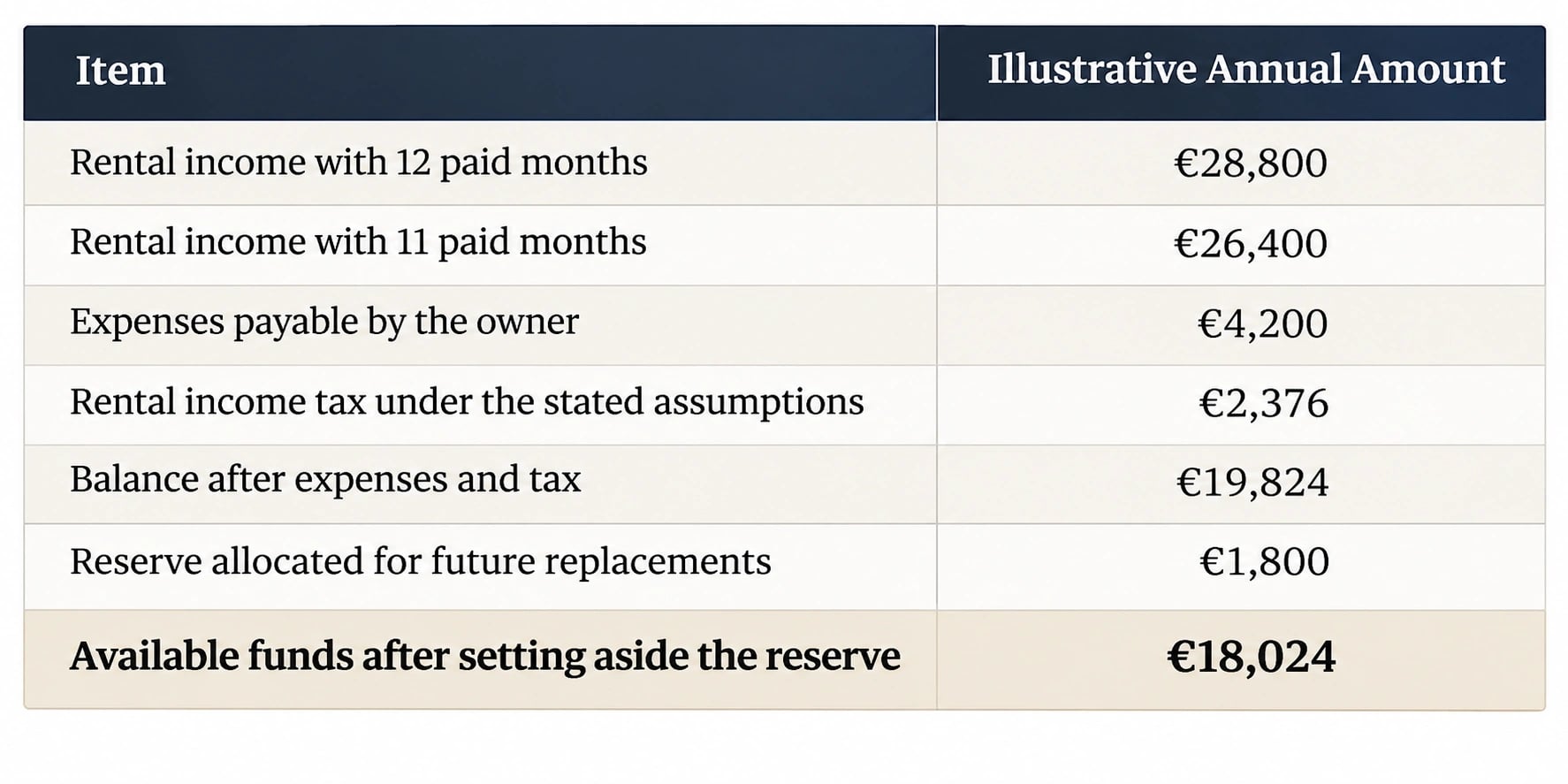
The illustrative €4,200 in expenses includes building-related charges payable by the owner, local taxes and fees, insurance, property management and routine maintenance. The reserve is money set aside for future expenses and remains your asset until it is used. The tax calculation assumes a Bulgarian tax-resident individual entitled to a statutory 10% expense deduction, with no tax reliefs or other reductions to the taxable base. The actual expenses of €4,200 are not additionally deductible under this calculation.
The potential annual rent relative to the total investment produces a gross rental yield of approximately 5.24%. After accounting for the vacant month, the stated expenses and income tax, the remaining amount represents approximately 3.60% of the €550,000 invested. After setting aside the reserve, available funds amount to approximately 3.28% of the investment. The example assumes no mortgage financing and excludes any potential change in the property's value.
Stress-Test Your Budget Against Lower Occupancy and Unexpected Repairs
Repeat the calculation assuming two vacant months, a lower rental price and an additional repair. Use figures appropriate to the property: replacing a single air-conditioning unit and repairing the heating system of an entire house involve very different financial commitments. Check whether the building is also facing upcoming shared expenses, such as roof, façade or lift repairs, which may not yet be reflected in the monthly maintenance charges.
If you are purchasing with a mortgage, deduct the annual loan repayments from the available funds to determine whether you will need to cover any shortfall. Repaying the principal reduces your outstanding debt, but it still requires a monthly cash outflow. Model potential interest rate changes in line with the terms of your specific loan. The investment becomes easier to assess when you know how much of a shortfall you could cover from other income sources and for how long.
Set your reserve according to your monthly obligations and the property's condition. It should allow you to cover essential repairs even during periods without a tenant. For high-value properties, pay particular attention to servicing and spare parts availability. A long wait for a specialised component can disrupt the use of the property even when sufficient funds have been allocated for the repair.
Furnish the Property for Comfort and Easy Maintenance
Prepare the property around the tenant's expected daily needs. Check the heating and cooling systems, provide sufficient storage and ensure appropriate lighting in every area. In a furnished apartment, test all appliances before taking photographs and arranging viewings. A minor issue with the dishwasher or blinds is easier to resolve before a tenant moves in, when it has yet to disrupt anyone's working day.
When choosing furniture and materials, consider cleaning requirements, repair options and the availability of replacement parts. Keep warranties, appliance model details and contractors' contact information. For more delicate or specialised surfaces, provide brief maintenance instructions so the tenant knows which cleaning products and methods are suitable. Premium finishes also require clear guidance on their proper care.
Before making a substantial additional investment, assess whether it meets actual market demand. If you spend another €20,000 on furnishings and expect the monthly rent to increase by €100, recovering that additional investment through the rent increase alone would take more than 16 years at full occupancy, before taxes and expenses. This calculation helps distinguish improvements with a sound financial justification from those made primarily out of personal preference.
Choose a Tenant After Discussing the Terms and Intended Length of Stay
Use the viewing to establish when the prospective tenant wants to move in, how long they intend to stay and which requirements are essential to them. Discuss the number of occupants, pets, parking arrangements and building rules. Check whether the rent, together with maintenance charges and utilities, fits their budget. Any information concerning the applicant's ability to pay should be collected appropriately and lawfully, with due respect for personal data protection.
For corporate lettings, clarify which party will sign the agreement, who will occupy the property and who will make the monthly payments. Establish the relevant contacts for day-to-day matters and the procedure to follow if the employee occupying the property changes. A corporate tenant also needs a rental agreement that reflects how the property will actually be used.
Evaluate offers in terms of the entire rental period, not just the monthly amount. Consider a hypothetical choice between €2,400 for 12 paid months and €2,600 for 11 paid months. Annual rental income would be €28,800 and €28,600 respectively. The second offer has a higher monthly rent but generates slightly less income over the period, even before accounting for any costs associated with changing tenants.
What Should Be Included in a Property Rental Agreement?
A well-drafted property rental agreement should identify the parties, describe the property and any associated premises or facilities, and specify the rental term and intended use. Clearly state the rental amount, payment due date and payment method, as well as which additional expenses each party is responsible for. If you wish to allow for rent adjustments, specify the relevant index or benchmark and the frequency of such adjustments.
Pay particular attention to the security deposit: what it covers, under what circumstances deductions may be made and when the remaining balance must be returned. Distinguish between routine maintenance, minor repairs and other repairs, ensuring that the provisions comply with applicable legal requirements. Establish procedures for reporting damage, arranging access for inspections or repairs by prior agreement, and responding to emergencies.
What Should You Consider in a Property Rental Agreement Between Private Individuals?
In a property rental agreement between private individuals, specify how notices will be exchanged, the applicable notice periods and the grounds for early termination. If several people will occupy the property, consult a lawyer on how best to identify the occupants and define the obligations of the signatories. Review any subletting provisions to ensure they reflect your intentions.
A template can provide a useful starting point, but every clause should be reviewed in the context of the specific property. Expensive furnishings, long rental terms and arrangements where the person paying the rent differs from the occupant deserve particular attention. Before signing, it is advisable to ensure that the legal review also covers how the agreement may be terminated and how the property will be returned to the landlord.
Hand Over the Property with an Inventory and Handover Report
Inspect the property together with the tenant and document its condition room by room. Include mutually agreed photographs, utility meter readings, an inventory of furniture and appliances, and a record of the keys, access cards and remote controls handed over. Note any existing signs of wear and tear. A general statement that "the property is handed over in excellent condition" leaves too many questions unanswered when the tenant eventually moves out.
Demonstrate how to operate the heating, security and other systems that require explanation. Provide contact details for reporting technical issues and clarify the procedure for emergencies. When the tenant moves out, conduct another inspection and prepare a check-out report before settling the security deposit in accordance with the agreement. Proper documentation helps protect both parties and makes it easier to resolve specific disputes concerning damage or unpaid bills.
What Tax Is Payable on Rental Income from Property?
Under the standard tax regime for a Bulgarian tax-resident individual, rental income is reduced by a statutory expense deduction of 10%, and the resulting taxable amount is subject to a 10% tax rate. In the absence of other applicable deductions or reliefs, this results in an effective tax of 9% of the rental income received. In the example, annual rental income of €26,400 produces taxable income of €23,760 and a tax liability of €2,376.
When planning for tax on property rental income, set aside the necessary funds as rental payments are received. The statutory expense deduction is a tax provision and may differ from your actual property-related expenses. Where the tenant is a private individual who is neither an enterprise nor a self-employed person, the landlord is responsible for calculating and paying the advance tax. Where the payer is an enterprise or a self-employed person, the payer generally withholds and remits the tax, while the landlord remains responsible for filing an annual tax return.
For the first three quarters of the year, the deadlines for advance tax payments and the corresponding declarations are 30 April, 31 July and 31 October. As a general rule, no advance tax is payable for the fourth quarter. However, an enterprise or self-employed payer may withhold tax if the landlord has expressly requested this in writing. The annual tax return, including Appendix No. 4, and any outstanding tax payment are due by 30 April of the following year. Where a deadline falls on a non-working day, the applicable rule extending it to the next working day applies.
Arrange Property Management Before the First Tenant Moves In
Decide who will monitor rental payments, organise repairs and attend the property's handover and return. If you plan to manage the property yourself, allow sufficient time and establish contacts with reliable contractors. If you appoint a professional property manager, clarify the scope of services, fees, reporting arrangements and spending limits for expenses that may be approved without additional authorisation.
At Unique Estates, we advise property owners on rental opportunities from the initial stage of purchasing an investment property. Our luxury and corporate lettings team can discuss market demand and property preparation with you, while our property management services include assistance with maintenance and property handovers. Specific responsibilities are agreed according to the property and the scope of services selected.
Before making an offer to purchase, prepare a calculation of the total investment, a well-supported rental price range and a budget that accounts for lower occupancy. Consider these alongside the amount of time you are prepared to devote to managing the property. This will help you choose a property whose rental operation you can manage in line with your personal financial objectives.
Frequently Asked Questions
What Should I Check When Buying a Property with an Existing Tenant?
Request the rental agreement and any amendments, a record of rental payments, information about the security deposit and the property handover report. Consult a lawyer to clarify how the existing agreement affects you as the buyer and how the deposit, prepaid rent and notification requirements should be handled. Purchasing the property does not automatically entitle you to change all the existing rental terms immediately.
Should I Include the Parking Space in the Rent?
Check how comparable properties are marketed and whether your prospective tenant is likely to need parking. Clearly state in both the listing and the rental agreement whether the parking space is included in the price and what rights of use are granted. Letting it separately requires a review of the relevant property documents and building regulations, as well as a separate assessment of the potential income and management requirements.
How Can I Tell Whether to Reduce the Rent After Listing the Property?
Monitor the quality of inquiries and the reasons prospective tenants decide not to proceed after a viewing. If applicants cite missing furnishings or previously undisclosed fees, address these issues first. If the total monthly cost exceeds that of comparable properties without a clear, justifiable advantage, reassess the asking rent, factoring in the financial loss from a longer vacancy period.
The legal and tax information is current as of October 2026. The examples are illustrative and do not constitute a guarantee of returns. A separate tax assessment is required where the property owner has a different tax status or the property is used for business purposes or short-term tourist accommodation.
Read more from category For buyers and tenants
The best areas for a house near Sofia
 20/11/2026
 For buyers and tenants
 Unique Estates

Open House at an Exceptional Duplex Apartment for Sale in Krastova Vada
17/11/2026For buyers and tenantsUnique Esattes
More Long-Term Tenants in Dubai Are Considering Buying Their Own Homes
11/11/2026For buyers and tenantsUnique Estates Dubai
What Are the Notary Fees When Buying a High-Value Property?
10/11/2026For buyers and tenantsUnique EstatesDo we need a broker when buying and selling a property?

Many of you probably ask this question when it comes time to change homes or purchase a new property. Why do I need an agency when there are websites show direct information from an owner?
Generally speaking, a real estate agent will save you time and effort, protect you from incorrect owners, and guide you seamlessly through the process.
How is the market price of a property determined?
The market price is determined by real estate professionals using the comparative market analysis method. The purpose of the analysis is to determine the correct price range in which to position a property when it is advertised for sale.
How are the undivided shares of a property calculated?
For each independent property, the undivided shares are calculated using the following formula:
Undivided Shares (%) = (Built-Up Area/Gross Floor Area) *100
Where:
Undivided Shares (%) is the size of the common areas adjacent to the property.
Built-Up Area (BA) is the built-up area of a property.
Gross Floor Area (GFA) is the total floor area contained within the entire building.
How is a property boundary determined?
A property boundary is determined by filing a petition to fix the boundary between properties. In order to determine the exact boundaries of a landed property, it is necessary to carry out the so-called tracing. This means to mark various points, lines, planes or surfaces on the terrain.
How is a rental agreement concluded?
According to the Bulgarian legislation, a rental agreement can be concluded both in written and oral form. In both cases, the agreement is considered valid and has legal force. However, the choice of an oral agreement hides significant risks, mainly due to the difficulties in proving the agreed terms and conditions.
How to terminate a tenancy agreement?
When you wish to terminate your tenancy agreement, you must comply with the period specified in the agreement and give prior written notice. If you wish to leave earlier than this period, you must pay a penalty to the landlord.
Where to find a four-room apartment in Sofia city for rent?
Unique Estates offers spacious and cozy four-room apartments for rent in Sofia city in the following neighborhoods: “Lozenets“, “Ivan Vazov“, “Iztok“, “Boyana“, “Simeonovo“, as well as in the center of the capital.
Why to buy a luxury property with Unique Estates?
With 17 years of experience in the luxury properties market in Bulgaria, we serve corporate and wealthy customers, offering an extensive database of 70 000 potential buyers. Our partnerships guarantee us services at international level, personal attention and fairness, which turns your dream property into reality.
How to make an expert appraisal of a property?
The first step in making an expert appraisal of a property is to contact a certified appraiser registered in the Chamber of Independent Appraisers in Bulgaria. For the process, you will need an ownership document, an up-to-date sketch or cadastral map of the property and other documents depending on the type of the property.
When market analyses and research are conducted?
Market analyses and research are conducted before making important business decisions, launching new products on the market, making investments, or expanding the business into new markets.
What does a market analysis involve?
The market analysis includes a complex analysis at several levels: general market analysis, industry market analysis, market analysis of an individual product. These assessments provide valuable data for informed decision making and strategic planning.
For whom can the real estate market analysis be useful?
The real estate market analysis can be useful for investors, home buyers, agents, financial institutions, property managers, end users, etc. It helps in making informed decisions and understanding market trends and property prices.
What does credit counseling for the purchase of a property include?
The service offers personalized assistance for granting a loan, which starts with an individual consultation to determine the parameters of the loan, such as purpose, collateral, repayment period and required documents. After that the intermediary submits suitable bank offers to the client and, upon selection, assists in the preparation of the documents.
How to easily find a gated community at the seaside?
You can find a gated community at the seaside on the websites of real estate agencies. Unique Estates offers luxury gated communities at the seaside. Explore our collection of gated communities and find the perfect one that suits your preferences.
 Call us